
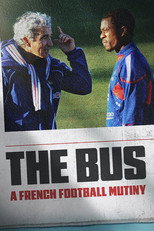
Le Bus: Les Bleus en grève gives us insider information on the truly catastrophic disaster that was France at WC 2010 in South Africa.
In prior years, Les Bleus had won WC 1998 at home, but they lost the WC 2006 final on Zidane’s head butt. Leaderless on the field, the team exited the 2008 Euros in the group stage. But WC 2010 became Les Bleus’ worst tournament experience of all time. This documentary explains how it all went down, and to me, the blame rests solely with manager Raymond Domenech.
WTF Happened??
The documentary largely centers around interviews with Raymond Domenech and his captain, Patrice Evra. We learn a little about their backgrounds and then the film explains how Raymond and Les Bleus entered the WC already under widespread criticism. Says Eric Cantona,
“Domenech est l’entraîneur le plus nul du football français depuis Louis XVI.”
Eric Cantona – Domenech is the worst coach in french football since Louis XVI
The team had performed badly at the 2008 Euros, and during WC qualifying, Thierry Henry had handled the ball into the goal, unfairly eliminating Ireland. We also learn key information from then press officer Francois Manardo, who in 2014 wrote a book about the work stoppage incident, commonly known as Knysna.
In reaction to all the criticism, Domenech tells the players that it is the team against the media, cuts off outside communications, and bars journalists from observing training. He also creates tension inside the team by making Patrice Evra the captain, over the more experienced William Gallas.
Once the games begin, things go badly: they tie Uruguay and then lose to Mexico. They are deemed “Les Imposteurs“. Domenech keeps a diary that shows he is becoming increasingly paranoid.
During the loss to Mexico, Anelka has a half-time locker room spat over Domenech’s tactics, and he is benched at the start of the second half. After the game, journalists hear about the argument, which they write up as Anelka swearing at Domenech.
In the present day interviews, both Domenech and Evra say that the swearing incident by Anelka did not happen. But rather than tell that to the world at the time, Domenech allowed the Federation to send Anelka home. It also appears that he sabotaged any attempt by Anelka to apologize to anyone.
This leads to the bus incident. Evra calls a team meeting. In support of the unfair treatment of Anelka, the players agree to refuse to train in the next practice. They ride the bus to the training grounds, sign autographs, and then get back on the bus, where they sit for an untold number of minutes because Domenech has taken away the keys. The strike leads to more adverse publicity for the players. Domenech does not allow Evra to speak to the press and apologize.
To further prevent the world from focusing on him as the problem, in the final group game against South Africa, Domenech keeps Evra and other great players off the pitch. Politically, this gives him an out if the team is eliminated from the tournament. He can say the players were at fault, because he had no choice but to bench them for their insurrection. It’s the kind of selfish, egotistical thing a narcissist would do: lose a game to prove a point and to try to bring disgrace to everyone but himself.
Why this film was made
In a JustWatch interview with Producer Nicolas Valode:
“We had a feeling that the account given at the time was simplistic, even downright caricatured. Our desire was to understand the mechanisms that led to such a collective crash. To do this, we needed to change perspectives, vary our viewpoints, and revisit the facts precisely to try to understand what really happened. …This approach broadened perspectives and allowed for the construction of a narrative quite different from what had become fixed in the collective memory.”
Producer Nicolas Valode
In Conclusion
It feels a little weird to return to an incident that happened on the world stage 15 years ago. Weird because it almost feels too soon, as trauma and emotions are still so raw. The players are now in their early 40s, and are young enough that they still haven’t emotionally recovered from the debacle.
The mid-70s manager Raymond Domenech is still arrogant enough to fuel your hate. He smirks when he says he didn’t care enough to tell the truth about what Anelka said. The worse the players look, the better for him. Raymond Domenech has renounced this film. He is a slimmer version of the Orange Oligarch, with better hair.
Le Bus: Les Bleus en grève leaves me feeling very sorry for the French players, who appear to still feel a little broken about their work stoppage. The incident devolved into a national question of their loyalty and French pride. But this film shows how Raymond Domenech had manipulated his players into a position where they were not allowed to speak for themselves.
For 15 years, France has wrongfully held the players fully and solely responsible for their performance at WC 2010. The incident led to a period of racism in French football and aided Marie Pen’s political career. (See my review of Les Bleus: Une Autre Histoire de France.) While it hurts to reopen 15 year old wounds, fans should pay attention to this documentary and realize that the players were victims of a manager putting himself above all else.
Netflix for WC 2026
BTW, I’m really enjoying that for WC 2026, along with new content, Netflix has brought back all its soccer documentaries, most of which I have reviewed. If you want to catch up with the films I have enjoyed the most, just search for the tag Netflix. Anything rated 8 or above should be worth your time!
8 Soccer Movie Mom Rating = 8
Resources:
- Released: 2026-05-13 (Netflix)
- In French with English subtitles
- 81 mins
- Original title is Le Bus: Les Bleus en grève (on strike)
- IMDB
- Wiki
- Director: Christophe Astruc , Jérôme Fritel
- Stars: Raymond Domenech , Patrice Evra
- Watch the Trailer in French
A little French
May-28-2026: I’m adding a google French translation of the summary
Le Bus: Les Bleus en grève (2026) revient sur les faits et montre comment l’entraîneur Raymond Domenech a fait porter le chapeau aux joueurs pour l’échec de l’équipe de France lors de la Coupe du monde 2010. Disponible sur Netflix sous le titre The Bus: A French Football Mutiny.
Retrouvez ma critique complète sur https://soccermoviemom.com/the-bus-2026/
